


A room that looks like a golf club, or a golf club that looks like a room?
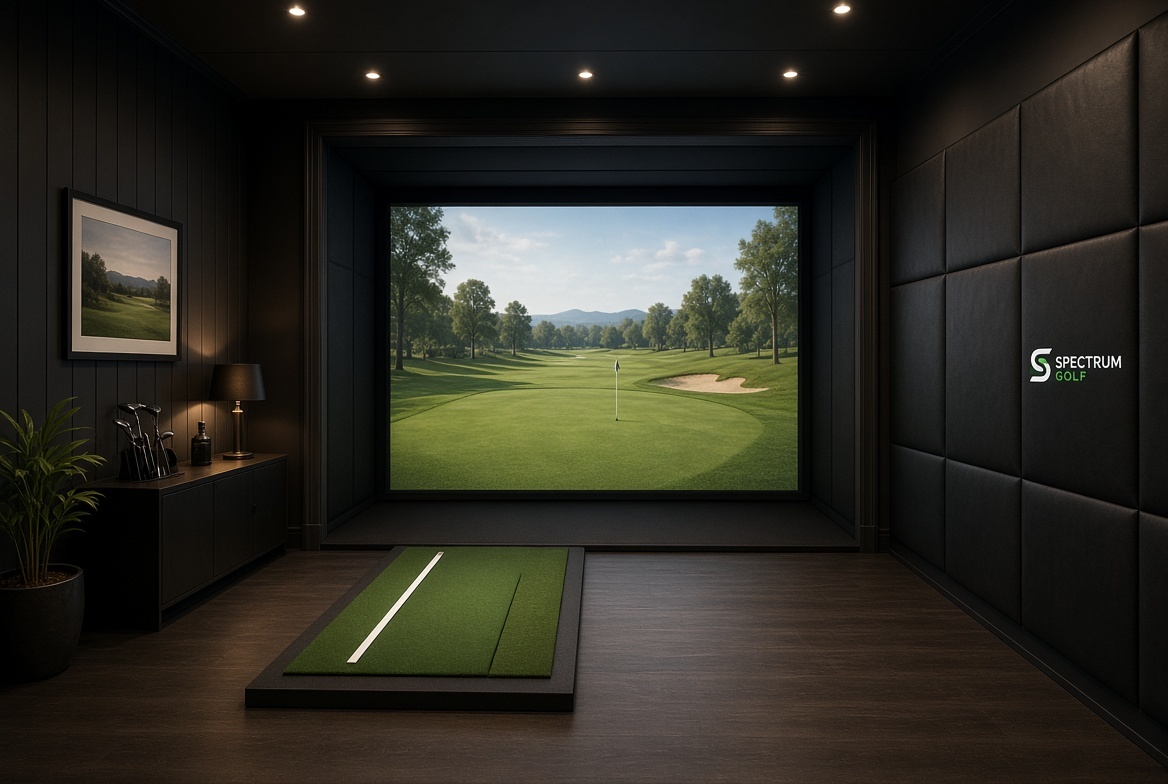
There are two very different dreams hiding under the phrase “home golf simulator.” In one, you walk into a dedicated golf room with dark walls, a clean screen, built-in lighting and a hitting mat that has its own address. In the other, you roll out a mat, step inside a freestanding enclosure and start playing while the rest of the room continues being a room. Both can be fantastic. They just solve different problems.
Built-in golf simulators aim for architectural integration. A freestanding golf simulator enclosure is a self-contained frame-and-screen environment that can often be assembled with less alteration to the room. Neither category tells you the quality of the launch monitor or impact screen. Nor does the word “built-in” guarantee safety, sound isolation or good projection.
This guide is for the buyer who cares about how the room works and feels after installation. Along the way, browse Spectrum Golf’s custom simulator options and the resources library. A good design begins with the room you have, rather than a photograph of a room someone else owns.
The built-in look: where the construction budget goes
A built-in golf simulator can use finished walls and ceilings to conceal framework, wiring, speakers, black fabric returns and protective padding. The screen often becomes an architectural opening: like a large picture window, except the landscape occasionally gets hit by a seven-iron. The effect can be spectacular when the visible projection area, frame details and lighting line up.
The hidden expense is the hiding. Contractors may be asked to create recessed lighting, relocate outlets, alter trim, finish walls and install protective panels. Custom carpentry is not automatically required, but the project has a habit of collecting seemingly small improvements. “Since we have the wall open” is one of the most expensive sentences in home renovation.
Built-in also means planning access. Screens wear; projectors change; electronics eventually need service. Leave a practical way to reach attachment points, cabling and mounting brackets. A seamless-looking design that needs partial demolition to replace a screen is beautiful in the same way a locked safe is beautiful when the key is missing.
Why freestanding enclosures have fans
A freestanding enclosure makes fewer demands on the building. The frame carries the screen and much of the protective fabric, which can make it attractive in rented property, finished basements or spaces where a custom build would be disproportionate to the budget. A packaged frame also provides consistent dimensions and a defined front opening.
Many buyers imagine freestanding means portable in the sense of “fold it after dinner.” It usually does not. These systems can be moveable with disassembly, but their assembled footprints are substantial. You still need sufficient height and width for a full swing, adequate rear clearance, safe side containment and a location where the frame will remain stable.
The SportScreen Parlour Series is a useful real-world example. The manufacturer describes an aluminum frame, impact screen, backing membrane, side screens, ceiling panel and baffles. It publishes a lifetime frame warranty and two-year limited warranty for remaining components. Those are product-specific terms, not a promise that every freestanding enclosure on the market offers the same coverage.
Aesthetics: the difference between tailored and temporary
People are allowed to care how a golf simulator looks. The game already makes enough demands on dignity. A built-in enclosure can create an elegant theater-like room by visually swallowing the side walls and ceiling transitions. Black fabric around the projected image can help the image feel framed and reduce distracting reflected light.
A freestanding enclosure shows more of its structure. That may be completely acceptable in a garage or training facility, where function wins and nobody is inspecting the corner trim. In a luxury finished room, the frame may compete with the intended architecture. An expertly selected freestanding unit can still look professional; the point is visual integration, not whether the frame deserves to be seen.
If visual polish is the deciding factor, sketch the view from the doorway when the projector is off. The simulator is not always running. A white impact surface, visible support rails and side curtains become part of the room even during the other twenty-three hours of the day.
Protection: the walls are innocent bystanders
Every enclosure must account for the ball that goes somewhere other than the center of the image. This is not an insult to your swing; it is an acknowledgment that even good golfers can produce spectacular surprises. A built-in simulator should have impact-resistant side treatment, ceiling protection, gap management and coverage around the frame. Attractive drywall without protection is just a future repair invoice.
A freestanding frame can come with standardized protective curtains, baffles and corner panels. Check what is included, how the pieces meet, and whether a ball can escape between the screen and the sides. The screen must have enough room behind it to deform during impact. Placing any impact surface flush against a hard wall makes the wall part of the impact event.
The manufacturer’s SportScreen FAQ gives example model-specific rear and side clearance recommendations, while Spectrum’s impact screen guide discusses materials and installation. Use those documents to formulate questions, then follow the exact installation and safety instructions for the system you select.
The screen itself: your most abused interior finish
A built-in system can make a screen look permanent, but the fabric remains a replaceable impact component. That reality should influence the design from day one. Leave access to rails, sleeves or fastening strips, and consider whether the replacement screen can pass through the finished opening without removing major trim.
Freestanding frames usually make the component boundaries more visible, which can simplify troubleshooting and screen replacement. However, proprietary sizes and attachments can limit replacement choices. When comparing packages, ask for screen fabric dimensions, finished opening dimensions and the attachment method. Find out whether the screen can be sourced separately and what the replacement costs.
Spectrum’s impact screen collection and poly spacer material for compatible retractable systems illustrate why fabric should be treated as its own decision. Image quality, noise, rebound and wear patterns depend on more than how the enclosure frame is dressed.
Acoustics and lighting: the atmosphere is engineered
A convincing simulator studio does not depend solely on screen resolution. Darker surfaces around the impact screen can reduce visual distraction, while controlled lighting makes the golfer visible without washing out the projected image. Avoid a bright ceiling fixture directly between projector and screen; that light may ruin image contrast before you ever blame the projector.
Noise is harder. Club impact, ball impact, vibration through mounts and sound transmission into adjacent rooms all play a role. Freestanding enclosures have less direct integration into the building but can still be loud. Built-ins can conceal acoustic layers, yet rigid connections may transmit vibration. Neither approach is a substitute for actual acoustic planning when a bedroom or neighboring property shares a wall.
For commercial indoor golf bays, the sound of several simultaneous shots can be more relevant than the peak noise of a single hit. Consider how furnishings, wall finishes and operational spacing influence the experience. The goal is a room that feels like a golf studio rather than a percussion experiment.
Budget: compare delivered rooms, not just frames
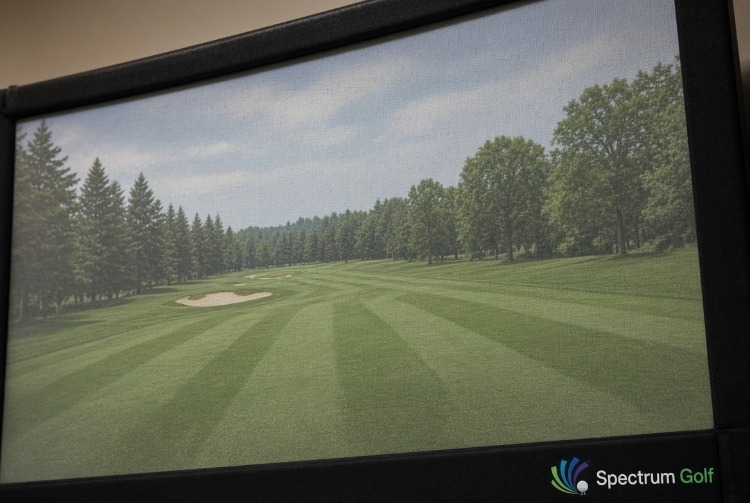
The easy comparison is a quoted freestanding enclosure kit versus a contractor estimate for a built-in opening. The fair comparison is the total usable simulator in each approach. Both need a launch monitor, suitable computer or device, software, hitting surface and projection or display. Both require safe dimensions and protection. Built-ins add finish work; freestanding packages may add anchoring, flooring and visual treatments.
For one transparent marketplace reference, SportScreen lists its Parlour freestanding series from $2,399.99 at the time of review. The number is a starting price for a particular manufacturer family, not an installation quote. A custom built-in can be cheaper or far more expensive depending on labor, selected finishes and how much work the owner performs.
Ask each bidder to break out enclosure, impact fabric, rear membrane, side protection, ceiling treatment, projector, launch monitor, wiring, installation and future screen replacement. Apples-to-apples budgeting is difficult, but apples-to-a-bare-frame budgeting is nearly useless.
The surprising winner in a multipurpose home
Built-in versus freestanding is sometimes the wrong binary. A household might value a built-in-looking front opening but need the hitting area back for workouts or guests. A retractable golf simulator screen with thoughtful trim can combine some visual integration with space flexibility. That turns the project into a different design problem, one about concealed hardware and movable protection.
Likewise, freestanding does not always mean temporary. A sturdy enclosure anchored in a dedicated room can be used for years. A built-in does not always mean immovable: some screens can be easily replaced and some electronics remain modular. These categories describe approaches, not immutable laws of interior design.
If the space must change purpose, read Spectrum’s retractable setup guide before committing to permanent framing. You may discover that retractability is more important than whether the visible front opening has decorative trim.
Small rooms demand more honesty than larger budgets
In compact simulator rooms, room geometry dominates product preference. A beautiful recessed opening cannot compensate for a driver that catches the ceiling. A freestanding enclosure with a nominal wide-screen opening may still require more total external width than the room provides. Measure the assembled frame as well as the impact surface.
The same principle applies to handedness. If two golfers swing from opposite sides, the safe hitting position and launch-monitor field of view may dictate the bay width. Overhead launch monitors also need the correct mounting height and ball-striking zone. Buying the prettiest enclosure first can create a chain of compromises elsewhere.
Walk through the complete indoor simulator components guide before fixing a design. Decide what the golfer, ball, projector and tracking equipment each need, then wrap the room around those requirements.
Commercial rooms: serviceability is a luxury feature
A commercial golf simulator enclosure gets hit by people who have different swings, different shoes and sometimes unfamiliar relationships with common sense. The protective design needs to accommodate mishits and routine inspection, and the screen must be practical to replace. A premium-looking built-in can be a smart investment when it makes the venue distinctive, but service access matters more than an invisible fastener.
Freestanding enclosures may help facilities create repeatable bay dimensions, test layouts and move equipment during renovations. Yet a busy venue needs stable framing, protected wiring, controlled walkways and clear operating procedures. A kit designed for occasional home practice should never be assumed appropriate for commercial traffic without checking its intended use and manufacturer guidance.
For a venue owner, model downtime and replacement labor. An enclosure that looks expensive but takes a day to service is expensive in ways that a catalog price does not reveal. Prioritize access to the screen attachment and projector mounting points from the very beginning.
Decision matrix: what kind of owner are you?
Choose built-in if this is a long-term dedicated golf room, the appearance of the architecture matters, and you can budget for customization and future access. Choose freestanding if you want a clearly specified enclosure package, fewer modifications to the property and a more modular path to installation. Choose retractable or hybrid if reclaiming space matters more than either label.
Then challenge the choice with three real-world questions. Will the household still like the room when the screen is off? Will you be able to replace the fabric after repeated use? And can the enclosure safely contain a poor shot from the least experienced person likely to play? These questions have a remarkable talent for exposing a design that looked perfect in a marketing photograph.
Spectrum can help plan custom impact screens, framing options and a complete room through its simulator catalog and consultation options. Send clear photographs, finished dimensions, the intended launch monitor and whether the room is permanent or shared. You will get a more useful fit conversation than “Which enclosure looks coolest?”
Build the simulator you will enjoy living with
The built-in look wins on visual integration when the project is planned well. The freestanding enclosure wins on a defined, modular framework and potentially easier installation. Neither wins automatically on screen durability, projection fidelity or safety. Those come from material selection, spacing, attachment and complete protection.
Before buying, review impact screen materials, screen installation methods and Spectrum’s other planning resources. Then request a custom fit through Spectrum Golf with your room measurements and desired design. The goal is simple: a space that looks intentional, works every day and survives the occasional shot that deserves an apology.
Frequently asked questions
Can I use a normal projector screen as a golf impact screen?
A standard home theater projection screen is not designed to absorb repeated golf ball impacts. Choose material specifically intended for golf ball impact, installed with the appropriate clearance and protection.
Are impact screens and enclosure frames the same purchase?
Often they are separate. Always inspect the listed contents for the screen, rear support, sides, ceiling, frame, baffles, roller, projector and launch monitor.
Can I install a golf simulator myself?
Some kits are suited to careful DIY assembly, but electrical work, structural anchoring and unusual ceiling conditions may require qualified professionals. Follow the model-specific installation requirements.