


A remote control is not a golf simulator. It can still change everything.
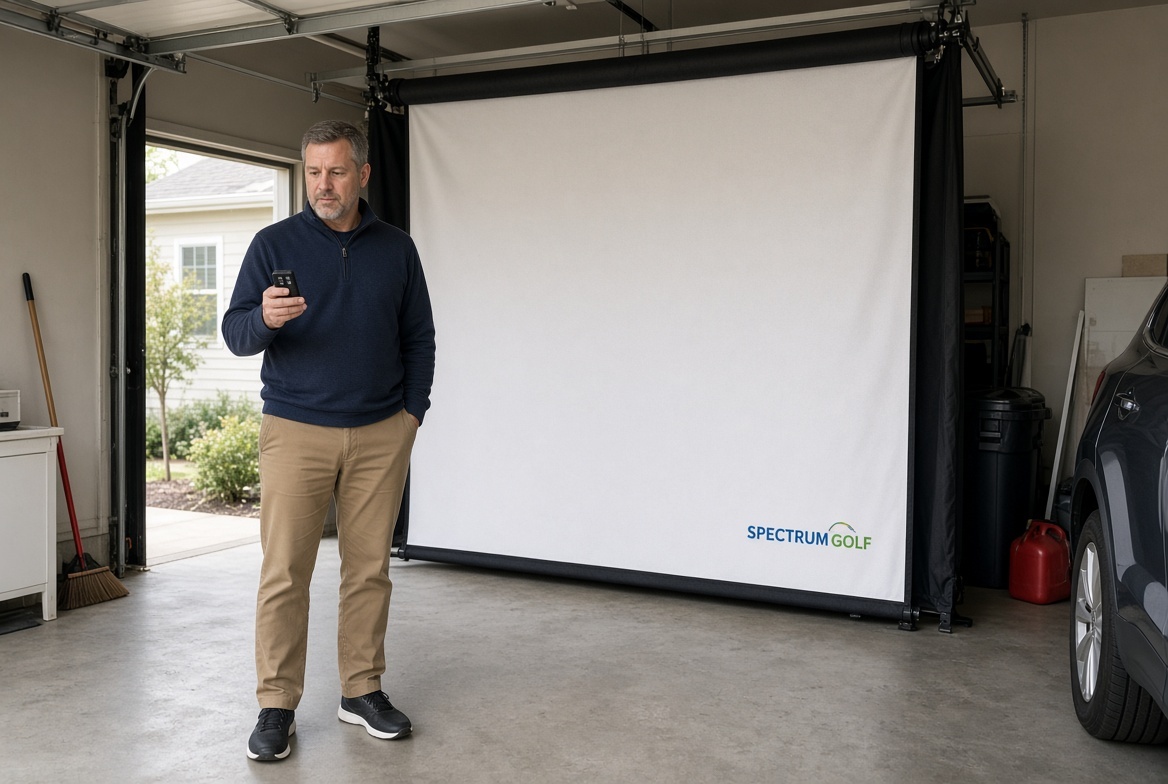
Imagine telling a golfer from twenty years ago that one day a practice bay could descend from the ceiling while the owner stood there holding a remote. They would either call it brilliant or assume someone had spent too much time in a garage. Both reactions are reasonable.
Retractable golf simulator technology has matured into several distinct product categories: complete roll-up enclosures, hybrid systems with sliding curtains, motorized impact screen rollers and DIY motor-and-screen kits. METechs and SportScreen occupy overlapping but not identical territory. Treating them as interchangeable is how people wind up with a perfectly functional motor attached to a screen that does not fit.
This guide looks at what the companies actually sell, how rollers and studio systems differ, and where Spectrum Golf fits into the conversation with compatible poly spacer screen material and custom sizing. We will keep the engineering interesting and the claims tied to manufacturer documentation.
First, separate the roller from the room
A retractable impact screen roller is a mechanical assembly built to raise and lower fabric. It may have a motor or a manual crank, brackets, a tube, controls and attachment hardware. It does not automatically include side containment, ceiling protection, a hitting mat or projection equipment. A complete enclosure packages more of those elements together.
SportScreen markets finished golf studio families, including the Vanish retractable enclosure, Vanish LITE hybrid-retractable enclosure and Parlour freestanding enclosure. METechs lists retractable golf impact screen systems plus motors, screen fabric, side panels and accessories. That matters because buyers can approach METechs as a component-based project or compare its more comprehensive kits, whereas SportScreen’s studio pages prominently present preconfigured enclosure families.
Neither approach is inherently superior. The difference is how much of the layout and specification work you want the supplier to solve. A package buys a clearer system boundary; components can offer flexibility if you understand every required piece.
What SportScreen Vanish actually offers
The SportScreen Vanish Series is marketed as a retractable golf enclosure that can operate with a hand crank or remote control. The company lists a premium three-ply impact screen, rear blackout or support membrane, side screens, ceiling panel, corner strips, baffles and wall or ceiling mounting hardware. The launch monitor, computer, turf, mat and software are excluded. That exclusion belongs on the first page of every budget conversation.
The manufacturer also lists five standard Vanish size options plus custom possibilities. Published aspect-ratio examples range from square to widescreen depending on model. Model numbers, bracket-to-bracket dimensions and usable projection areas differ, so order only after checking the dimensional diagrams for the exact variant.
An important detail: SportScreen specifies rear and side standoff distances for its Vanish systems. This is a reminder that a retractable screen still needs space to move and to absorb impact. Rolling up does not remove the laws of physics from the bay.
Vanish LITE is a different answer to the same problem
Vanish LITE pares back the full retractable concept into a hybrid. According to SportScreen, the front impact screen and rear membrane retract while the side curtains move along tracks and pin back when out of use. The listed package includes a premium three-ply impact screen, rear membrane, side curtains, ceiling panel, baffles and mounting hardware.
That may fit a garage where the front wall needs to clear regularly but the owner does not require every side component to operate on its own motorized roller. The tradeoff is that setup still includes managing the side curtains. The simplicity of a remote-control front screen should not hide the rest of the routine.
SportScreen lists a one-year manufacturer-defect warranty for the LITE series, compared with two years for Vanish on its current product information. Warranty terms can change and differ by component, so read the precise conditions and exclusions before treating a warranty headline as a durability test.
Parlour belongs in the comparison, even without a motor
SportScreen’s Parlour Series is freestanding, not retractable. Why mention it in a roller article? Because a remarkable number of shoppers start by wanting a disappearing screen and eventually discover that they have a dedicated room. In that case a stable frame can solve the real problem with less mechanical complexity.
Parlour’s documented package includes an aluminum frame, impact screen, rear membrane, side screens, ceiling panel, baffles and assembly hardware. The company publishes a lifetime warranty for the frame and limited coverage for other components. It also offers an optional frame-mounted launch monitor bracket, subject to compatibility with the specific tracking device.
SportScreen’s own collection page currently advertises Parlour starting at $2,399.99, Vanish LITE at $2,299.99 and Vanish at $2,999.99. These are different product offerings, not equivalent-size quotations; prices and included features should be checked before publishing a live comparison.
METechs: a more component-driven catalog
METechs’ retractable golf screen category presents DIY-ready systems and individual parts, including drive motors, screen panels and ceiling-related assemblies. Its storefront also lists a ready-made motorized golf impact screen kit and a premium three-layer screen fabric identified as GI320GWB-Pro. Specific configurations, sizes and price points vary across its catalog.
This structure appeals to buyers who already have a room plan or an enclosure frame and want to source a roller and compatible fabric separately. It can also appeal to someone replacing a worn screen rather than rebuilding the entire bay. The flexibility comes with homework: roller width, screen weight, drop length, control type, mounting support and side containment all need to agree.
Check the exact product page rather than assuming every METechs item is a complete simulator enclosure. A motorized front screen is useful hardware, but it is not the ceiling baffle that stops your friend’s ambitious lob wedge.
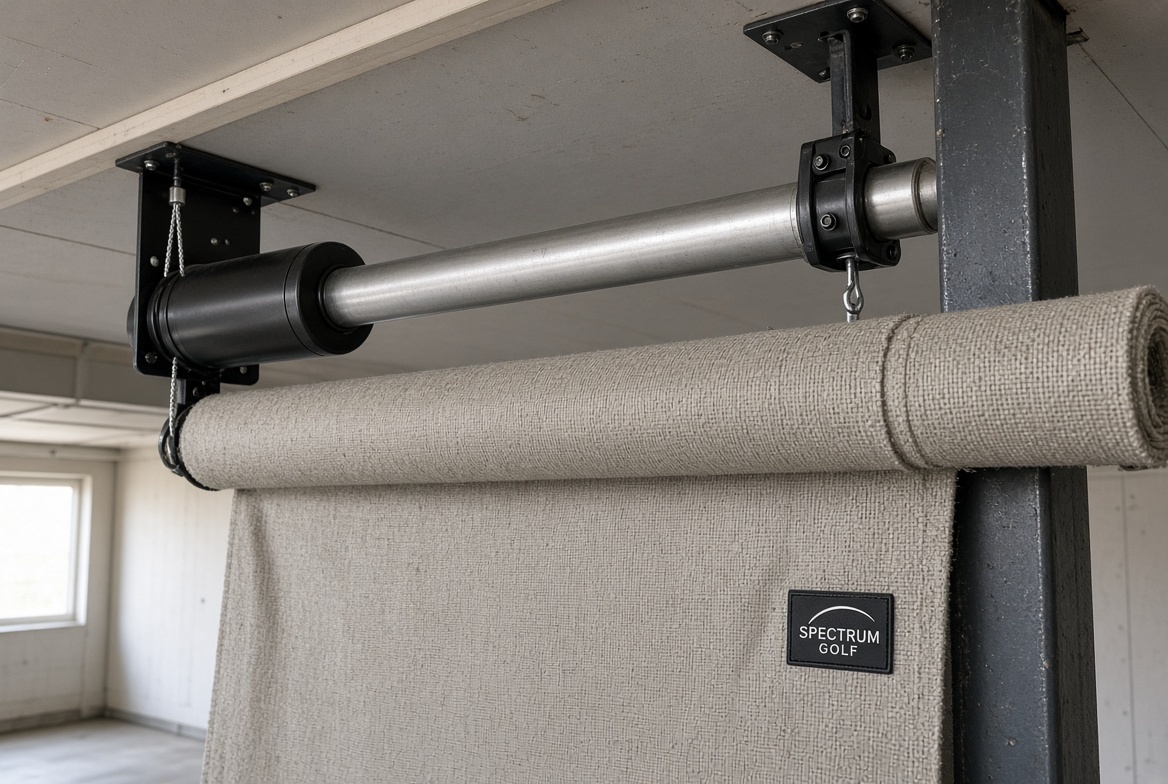
The engineering checklist: motor, tube, fabric and mounting
Before purchasing a motorized golf impact screen, get the roller tube dimensions, motor capacity, expected screen weight and allowable drop. Heavy multilayer fabric requires appropriate drive capacity. A fabric that rolls loosely or unevenly can track poorly and put strain on seams and attachment points.
Also ask whether the system has adjustable travel limits, how it is controlled and where power enters the assembly. A standard electrical outlet may work for a published product, but wiring, outlet placement and safe mounting still need to follow local requirements. SportScreen’s published FAQ, for example, lists 120 V, 60 Hz, 280 W/2.4 A for its motor and a four-minute operating limit before thermal protection may interrupt use. That is a manufacturer-specific specification, not a universal motor requirement.
Wall and ceiling structure matter as much as electronics. A beautifully functioning roller anchored poorly is a mechanical hazard. Use the product installation instructions and a qualified professional when the mounting substrate, electrical work or load path is uncertain.
Why fabric compatibility deserves its own conversation
A roller system is only as helpful as the impact surface attached to it. The fabric needs to survive repeated ball strikes, display the intended projection well and roll consistently. Thickness, weight, finish and construction all influence the experience. More layers do not automatically mean a better match for every tube or motor.
Spectrum’s SportScreen/METech-compatible poly spacer screen uses a cushioned construction described on its product page as two outer layers separated by a nylon cushioning structure, approximately 3 mm thick. Spectrum also advertises custom length options and discusses top extensions and attachment details. Those are specific features worth examining for a replacement or upgrade.
Before ordering a retrofit, confirm the existing roller dimensions and the manufacturer’s compatibility guidance. Spectrum’s page advises customers to send room pictures and measurements for sizing assistance and notes its own relationship between screen and roller size. Treat these as instructions for that offering, not general measurements that can be imposed on every roller system.
The 3-ply versus poly-spacer question
Both brands and independent screen suppliers use “three layer” language, but construction words can conceal very different textile structures. A laminated stack, a knit spacer textile and a screen plus rear support membrane are not interchangeable simply because someone counted to three.
Start with function. Does the fabric produce a sharp projected image at your planned brightness? Does it have adequate room to deform? Is rebound manageable under the manufacturer’s tested installation conditions? Can the finished fabric roll without developing troublesome folds? Is the surface straightforward to replace? These questions beat an unsupported superlative like “ultimate commercial grade.”
For a broader understanding of screen material and the effects of tension, read Spectrum’s golf impact screen guide and its installation discussion. Request material details and samples when possible. The projector may care about surface texture while the motor cares about weight; both deserve a vote.
How much does a motorized golf screen really cost?
For product context, METechs currently features a GI320GWB-Pro ready-made motorized golf impact screen kit listed at $1,112.64 and premium fabric listed at $284.14 on its store homepage. Those are storefront examples at the time of review; options and prices can change. SportScreen publishes starting prices for broader enclosure products in the low thousands of dollars. Comparing those figures as if they represent the same complete system would be misleading.
A useful quote should specify what arrives in the boxes: screen, roller, motor, power components, remote, mounting brackets, side curtains, top protection, baffles, backing membrane and instructions. Then add launch monitor, mat, projector, computer, software and installation labor where relevant.
For an existing DIY enclosure, a replacement roller or screen may be the most economical route. For someone starting with bare drywall and optimism, a comprehensive studio package may reduce design mistakes. Value is not only what you pay; it is how many missing components you discover after delivery.
Garage layouts: the little things that make big trouble
Garage door rails are famously indifferent to golf ambitions. When a retractable system is mounted close to an overhead door, the roller, brackets and descending screen need clearance throughout the door’s travel. A parked car also requires safe stowed-space geometry. Measure both scenarios, with the garage in golf mode and daily-life mode.
Power-cord placement can influence which side of the roller you mount the motor. The screen drop must clear lighting and any shelving, and the projector must stay clear of the golfer’s swing. Side protection should deploy reliably, with gaps closed. It is tempting to optimize the beautiful front view and treat the side curtain as a late accessory. That is precisely the wrong order for a system designed to catch mis-hits.
If the space is unusually shaped, send drawings or photographs before purchasing. SportScreen says it offers custom options and adjustable mounting solutions for certain garage obstacles. Spectrum likewise invites measurements for a compatible screen-and-roller fit discussion.
Which buyer should choose which route?
Choose a complete Vanish-style enclosure if you want a clearly described retractable studio family and a system with the listed overhead and side containment. Consider Vanish LITE if the front wall must clear but sliding curtains are acceptable. Consider Parlour if the room is dedicated and retractability would add cost without adding practical value.
Explore METechs if you want motorized roller parts, a ready-made retractable screen kit or a more component-driven build. Consider Spectrum’s compatible fabric options when a screen upgrade or custom dimension is the project’s central need. None of those suggestions is a blanket quality ranking. They are different procurement approaches with different responsibilities.
Commercial buyers should also ask about replacement supply, daily operating cycles, staff procedures and long-term service access. Any system deployed in an occupied business needs a level of planning beyond whether the remote works during a showroom demonstration.
A better RFQ than “How much for a golf roller?”
Send the seller room width and ceiling height, usable screen opening, desired projection aspect ratio, rear-wall clearance, full-swing clearance, expected frequency of use, whether both left- and right-handed players will use the bay, and which launch monitor and projector are planned. Include photographs of the mounting surface and door tracks.
Then ask: Is this a screen-only kit or full enclosure? What is included for top and side protection? What are the warranty terms by component? What happens when screen fabric wears? Can I buy replacement material without replacing the motor? Can the chosen fabric roll on this exact tube? What is the safe operating procedure if the motor fails?
A supplier who can answer these questions is helping you buy a system. A supplier who replies with only an adjective and a discount code is helping you collect packages.
The bottom line: buy the system, not the button
SportScreen and METechs both deserve a place in a serious retractable golf simulator comparison because they give buyers concrete ways to solve the space problem. SportScreen’s families emphasize defined studio packages, while METechs’ catalog offers several component and kit routes. Spectrum brings compatible poly spacer golf impact screen choices and custom sizing into the equation.
Review Spectrum’s retractable golf screen guide, compare the published SportScreen specifications and METechs offerings, then bring Spectrum your measurements. Visit Spectrum Golf to discuss the screen, roller fit and the rest of the enclosure before purchasing. The ideal outcome is gloriously uneventful: the screen rolls down, the ball stays contained, the image looks good, and the room is yours again after the round.
Frequently asked questions
Can I use a normal projector screen as a golf impact screen?
A standard home theater projection screen is not designed to absorb repeated golf ball impacts. Choose material specifically intended for golf ball impact, installed with the appropriate clearance and protection.
Are impact screens and enclosure frames the same purchase?
Often they are separate. Always inspect the listed contents for the screen, rear support, sides, ceiling, frame, baffles, roller, projector and launch monitor.
Can I install a golf simulator myself?
Some kits are suited to careful DIY assembly, but electrical work, structural anchoring and unusual ceiling conditions may require qualified professionals. Follow the model-specific installation requirements.