


Poly Spacer vs Single-Layer Golf Impact Screens: What Actually Changes?
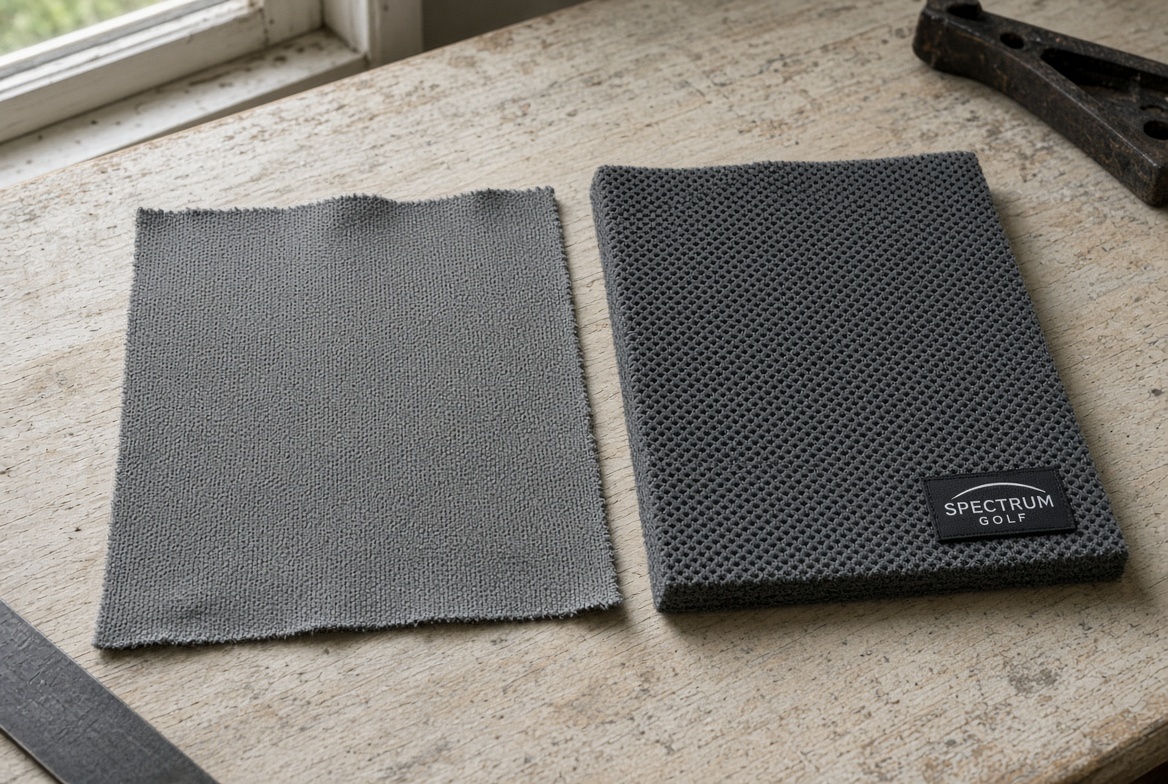
Poly spacer versus single-layer: the screen material decision
Here is the part of golf simulator ownership that receives roughly one percent of the attention it deserves: the fabric. A launch monitor may arrive in a sleek box with sophisticated software, but the screen is the component you deliberately hit with fast-moving golf balls. Your choice between a poly spacer golf impact screen and a single-layer polyester golf screen will influence projection appearance, sound, ball rebound, wear patterns, installation complexity, and budget.
This comparison is for home simulator builders, garage golfers, commercial indoor golf facilities, and anyone replacing an old screen. It covers construction and tradeoffs rather than declaring one technology universally superior. Properly engineered examples of either category may outperform poorly made alternatives. The same fabric can also feel completely different depending on installation tension and rear clearance.
For product context, explore Spectrum’s golf impact screens, including Poly Blend 95 and its Poly Spacer DIY options. The Spectrum homepage is a starting point for discussing custom sizes and complete enclosure needs. The right choice is the one suited to your expected use, not the one with the most dramatic product photography.
Understanding single-layer polyester golf impact screens
A single-layer golf impact screen relies primarily on one knitted or woven fabric plane to intercept the ball and present the projected picture. Its performance depends on yarn strength, knit density, fabric mass, stretch, finishing, and attachment design. A well-made single layer is not simply a thin white curtain. It is an engineered textile made for repeat impacts, but without the cushioning architecture of some spacer constructions.
Single-layer screens can be less expensive, lighter, easier to fold, and suitable for uncomplicated DIY setups. They may work particularly well for casual practice and spaces where replacement cost matters. However, a lighter construction can transmit a sharper impact sound or exhibit greater rebound in some installations. These are tendencies, not test results that automatically apply to every named product.
Spectrum Poly Blend 95 is presented as a single-layer product option with reinforced edging and custom finishing. Its page mentions entry-level golf enclosures and different size/aspect-ratio configurations. Buyers can use those descriptions to decide what to ask about, while confirming the current selected size, finish, and suitability for their hitting speed.
What makes 3D poly spacer different?
In a typical three-dimensional spacer textile, two surface layers are connected by internal yarns that form a separated structure. Think of a miniature bridge system between two fabric faces, not merely three sheets stacked like laundry. Depending on the exact design, that internal structure can compress and recover when struck. This is why spacer fabric is used in applications where thickness, airflow, cushioning, and dimensional behavior matter.
A golf impact screen built with suitable spacer material can be designed to distribute impact forces and alter sound and bounce characteristics. The faces can also be tuned for projection texture. But the label “3D poly spacer” says nothing by itself about ball-speed tolerance, thickness under compression, or expected service life. Two spacer fabrics that look similar in online photographs may be completely different under repeated impacts.
Manufacturers may also describe three-layer screens that are not strictly the same as one integrated spacer knit. Carl’s Place Premium material description references three layers with a noise-dampening middle layer. Buyers should compare a construction diagram and physical sample rather than assuming every triple-layer or spacer product uses identical engineering.
Bounceback, speed and impact absorption
Ball rebound is affected by the kinetic energy of the strike, fabric elasticity, mounting tension, rear clearance, surrounding frame geometry, and any supporting net. There is no universal rebound percentage determined by the word “polyester.” A drum-tight installation may reflect energy sharply, while a properly tensioned screen allowed to deflect can absorb and redirect energy differently. Always follow the product manufacturer’s guidance.
Spacer structures may help manage the impact because they offer more than a single plane of fabric to deform. Still, internal yarns can stiffen a structure, and different knit density changes how that deformation feels. A single-layer screen that is appropriately mounted may behave better than a poorly mounted premium spacer screen. That is why meaningful product testing requires the same ball speed, mounting geometry, and measurement method.
Never judge impact safety by watching a soft wedge chip into a sample square. A proper simulator needs a screen rated or documented for the intended use, appropriate clearance behind it, protection around the frame, and a safe hitting distance. Consult Spectrum’s full impact screen guide and enclosure products when building the complete containment area.
Noise: the feature your household notices first
The first time someone hits a driver indoors, the room delivers a reminder that sound behaves differently inside drywall and concrete. You hear the club, the ball, the screen impact, and whatever vibration the mounting hardware sends through the structure. Screen fabric influences one portion of that noise. Spacer designs may soften the strike, but room acoustics and frame isolation can dominate the overall sound.
It is tempting to read “quiet screen” and assume the simulator will become library-compatible. It will not. A foam-lined enclosure, thoughtful frame padding, decoupled hardware, and safe placement relative to neighboring rooms can make a meaningful difference. A hard rear surface directly behind the fabric can produce a separate impact and vibration problem if the screen travels too far.
If sound is a key buying criterion, request comparative demonstrations under consistent conditions and ask how measurements were made. Decibels reported at different distances or ball speeds are not directly comparable. For shared spaces, consider quieter practice schedules and enclosure design along with material selection. The golf screen is important; the room gets a vote.
Picture quality and projector considerations
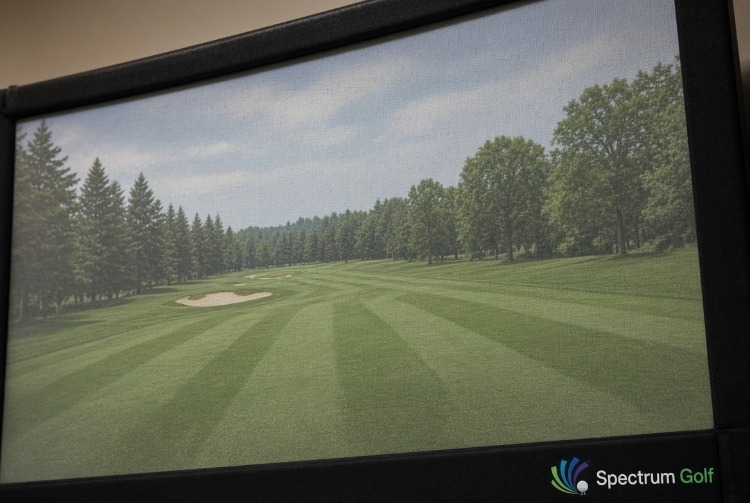
A golf simulator screen is simultaneously a stopping surface and a projection canvas. Its front-face uniformity affects visible texture, moiré, and how clearly projected lines and ball-flight graphics appear. Dense, consistent surfaces can create a smoother image, but projector resolution is not the same as screen resolution. A screen does not become “4K” simply because a seller prints four characters on a listing.
Projection depends on the combination of pixel density, projector lumens, lens quality, throw distance, ambient light, screen color, surface gain, and physical flatness. A material that performs beautifully in a dark dedicated room may look washed out with garage doors open. Gray screens can improve perceived dark tones in some ambient-light situations, often at the expense of image brightness. A brighter white fabric may be preferable in a controlled dark room.
Screen wrinkles and tension also matter. A heavier spacer product may hang with different drape behavior from a lightweight single-layer material. Edge reinforcement, evenly spaced attachments, and the geometry of the frame determine how clean the front looks. The screen sizing and materials guide provides related planning considerations.
Durability and realistic replacement economics
A golf impact screen wears where balls repeatedly strike it. Dirt and damaged ball covers can speed abrasion. A limited hitting zone may wear faster than a larger screen receiving a varied strike pattern. Seams and attachment points may fail separately from the central fabric. No honest manufacturer should promise that every buyer gets the same number of swings from a textile regardless of speed and usage.
When comparing material life, examine a documented test description. “Tested to thousands of hits” is much more useful if you know the ball speed, strike location, screen tension, inspection criteria, and whether the material was new or preconditioned. A thicker fabric may last longer under one set of conditions while another construction performs better elsewhere. Do not substitute thickness for testing.
Calculate cost per period of useful service rather than assuming the most expensive screen is the best value. A casual golfer may prefer an affordable single-layer Poly Blend screen. A facility running multiple bays may put greater weight on cushioned Poly Spacer choices and consistent replacement stock. Neither decision is irrational; they solve different problems.
Installation, grommets and roller compatibility
A single-layer sheet may be easy to mount, but the attachment pattern still determines stress distribution. Grommets too close to the edge or without reinforcement can concentrate loads. Over-tightening creates hard tension paths and may change rebound. Sleeves, loop fastener strips, and custom hems can solve particular designs, but only when measured properly. A screen that fits on paper can fail in the final six inches of installation.
Spacer fabrics can be thicker and may require special consideration at hems and roller systems. Some retractable hardware has limitations on fabric thickness and roll diameter. Before ordering custom spacer material for a roller, confirm the motor or manual roller manufacturer’s specifications, sleeve layout, total drop, and allowable fabric weight. Assuming any material rolls onto any tube is a surprisingly effective way to buy the same product twice.
A fixed frame generally gives more predictable tension and coverage. A retractable setup provides multi-use flexibility but introduces moving components and alignment challenges. The enclosure category can help shoppers think about the surrounding system. Consult the actual instructions for your specific frame and screen before following generic installation diagrams.
A practical material-selection matrix
Choose a single-layer impact screen when the setup is occasional, the budget is firm, and a credible manufacturer confirms suitability for the expected strikes. It is also appropriate when you value a lighter fabric or a straightforward fixed-frame installation. Leave money for side and overhead protection. A bargain front panel surrounded by exposed hard surfaces is not a budget triumph.
Lean toward a properly specified spacer or multilayer impact screen when the simulator sees frequent hard shots, sound sensitivity is important, or the installation has demanding projection expectations. For commercial golf bays, the right answer may also depend on maintenance downtime, quick reorder capability, documented material performance, and local fire-code requirements. Request material information, swatches, and clear support terms.
For either option, confirm five inputs before purchase: actual finished dimensions, safe striking and rear clearances, target aspect ratio, attachment method, and documented use limits. If any one is uncertain, resolve it before comparing prices. A technically excellent screen in the wrong opening becomes an expensive wall decoration.
Poly spacer and single layer: questions buyers ask
Is three-layer always quieter? Many multilayer products aim to dampen noise, but it depends on the construction and installation. Is a single-layer screen only for beginners? Not necessarily; use requirements and manufacturer documentation are more meaningful than labels. Does a spacer fabric automatically prevent bounceback? No. No textile removes the need for proper tension, clearance, and containment.
Can I use any material with a retractable enclosure? No. Check the roller system’s supported thickness, weight, and mounting style. Is a projection screen equivalent to an impact screen? Absolutely not. General cinema projection fabric is not necessarily made or rated to absorb golf-ball strikes. Buy purpose-built impact material with documented intended use.
To select your construction, compare Spectrum’s golf screens, its Poly Blend option, and Poly Spacer products with the measurements of your room. The stronger purchasing decision is the one you can explain in terms of fabric, usage, safety, and installation rather than one impressive adjective.
The real-world sample test before committing to a screen
If a supplier can provide small samples, inspect the fabric in the lighting your finished simulator will use. Shine a projected image across each sample to see surface texture and apparent brightness, remembering that a small sample does not reveal how a full-size screen hangs. Feel the face knit, inspect cut edges and seams, and compare nominal thickness to the published specification. A physical sample is far more informative than enlarging the same marketing photograph fifty times.
Do not strike an unsecured sample with a real golf ball. A proper impact test requires a controlled, protected setup and appropriate personnel. For consumers, request maker testing or a demonstration performed in a complete enclosure under known conditions. For commercial buyers, document the intended use and ask for written specifications. When comparing the results, look beyond the quietest individual impact to long-term dimensional stability, edge stress, and replacement availability.
Then build a decision around your actual priorities. Some homeowners prioritize projection clarity and a limited budget, others want reduced impact noise, and commercial operators may prize predictability and supply continuity. Discuss those priorities while exploring Spectrum’s golf screens and enclosures. Fabric selection becomes easier when every feature is connected to a reason, rather than a mysterious number of layers.
Choose the fabric that earns its place in your simulator
The best golf impact screen material is not defined by an internet ranking. It is the textile that fits the room, handles the expected workload, meets the installation requirements, and projects the image you actually want to see. The tradeoffs between poly spacer and single layer are real, and both deserve a fair look.
Bring your opening dimensions, projected aspect ratio, and usage plan to Spectrum Golf. Review its impact screens and materials guide, then request the construction and finish that suit your bay. Good screen choices turn an expensive collection of electronics and tubes into a simulator people genuinely want to use.