


The garage has two jobs. They occasionally disagree.
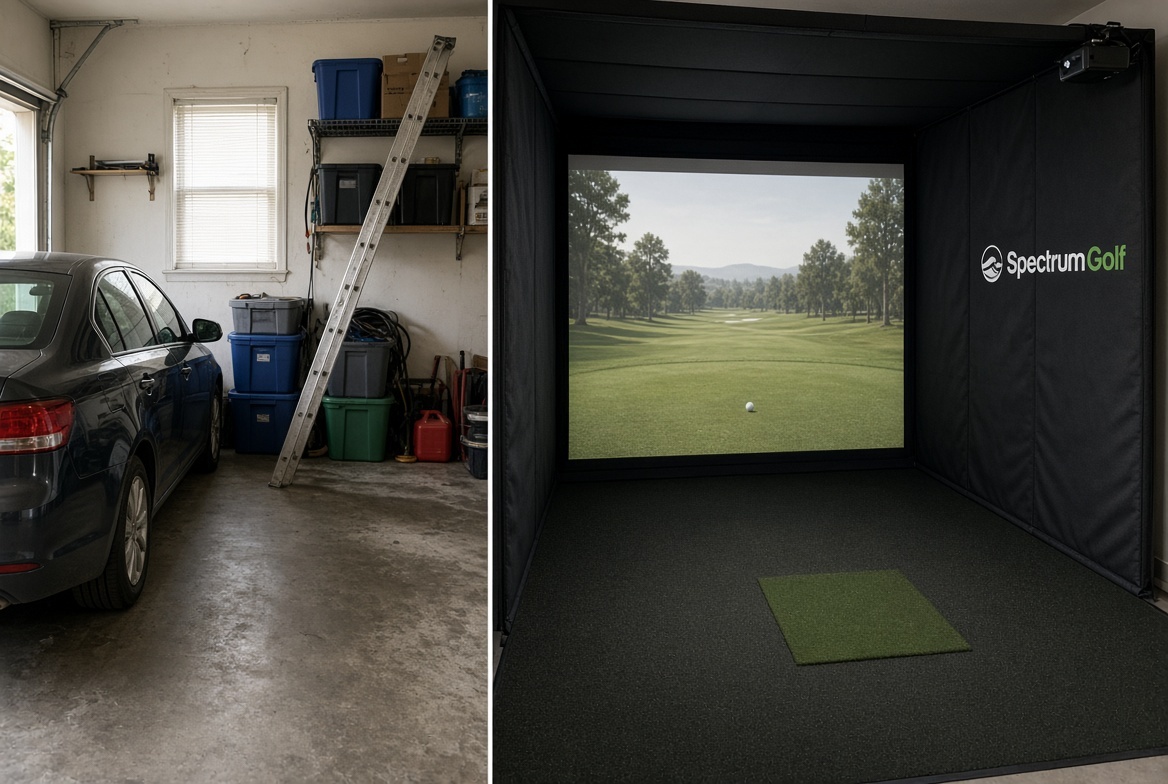
At 7:15 on a Tuesday, your garage is a perfectly ordinary place: a car, a ladder, three storage bins whose contents have become family folklore. At 7:30, you want to play Pebble Beach in November. This is the argument behind the retractable golf simulator enclosure versus fixed enclosure debate. The question is less about whether a golf impact screen can roll up. It is about whether the room has to return to normal when the round is over.
A fixed indoor golf enclosure is a dedicated hitting bay, usually built around a frame, screen, side protection and overhead protection. A retractable golf enclosure uses a roller mechanism for its screen and sometimes its protective sides, allowing some or all of the bay to disappear. Both can create excellent home golf simulators. Both can also become expensive mistakes if the ceiling, swing path or garage door tracks were ignored because a product photo looked irresistible.
If the room is doing double duty, browse Spectrum Golf’s retractable screen guide and the Spectrum Golf homepage early in the planning process. The right design begins with dimensions, not a shopping-cart victory lap.
The comparison nobody should skip: actual daily use
A retractable screen has an appealing party trick: after a session, the screen goes up and the room reappears. But count the whole ritual. Will you also move the mat, protect the ceiling, pull back side curtains, raise a projector or cover a floor cable? A retractable impact screen alone does not make the entire simulator retractable. It might simply turn a permanent obstruction into a movable one.
Fixed golf simulator enclosures excel at zero-friction practice. Walk in, turn on the launch monitor, hit balls. In a finished basement, detached practice room or commercial bay, this consistency matters. A session that starts in sixty seconds often gets used more than one that begins with ten minutes of furniture choreography. That is a usability argument, not a claim that fixed fabric measures better ball flight.
For a shared garage, mobility can matter more than convenience. If cars, bikes or the family’s accumulated sporting goods must occupy the hitting area on weekdays, a motorized golf simulator screen may keep the project viable. The useful question: how many minutes will this system take to be safe and ready, including every curtain, pad and net?
Floor space is not the same thing as swing space
Golfers frequently measure the screen wall and declare success. Then the first practice swing finds a ceiling fan. A proper golf simulator room layout accounts for club clearance, golfer height, stance width, left- and right-handed play, launch-monitor placement, projector throw distance, and the area behind the impact screen. The whole club arc matters. The screen dimensions are only one part of the geometry.
A fixed enclosure occupies the same footprint all day. A retractable unit may restore floor area when stored, but the ceiling-mounted roller, brackets, rails and any parked curtains still occupy physical space. Garage door tracks deserve particular attention because they already own the most inconvenient real estate in the room.
SportScreen says its Vanish mounting options include wall or ceiling brackets and calls for about 8–12 inches behind the rear screen. It also publishes model-dependent heights and widths. Those figures are manufacturer installation guidance for those models, not a universal safety specification for every golf simulator. Confirm your exact hardware and room conditions using the SportScreen technical FAQ.
The economics of a screen that disappears
For a fixed golf simulator enclosure, much of the money goes toward fabric, framing, edge attachment, baffles and padding. For retractable equipment, add a roller, brackets, possible motor, controls, side-track hardware and more complicated installation. There is no honest universal dollar premium; system size, completeness and motor choice swing the comparison. A cheap retractable screen without side protection may cost less than a highly finished fixed studio, while providing a very different level of coverage.
To ground the market, SportScreen currently displays starting prices around $2,999.99 for Vanish, $2,299.99 for Vanish LITE and $2,399.99 for its freestanding Parlour series. These are advertised entry points for different products, not matched-price quotes; they can change. See the manufacturer’s collection for current configurations. Additional expenses may include professional mounting, a dedicated outlet, electrical work, launch monitor, turf, projector and software.
Total cost of ownership also matters. Moving parts can require troubleshooting and eventual replacement. A fixed frame needs screen tension checks and fabric maintenance. Rather than ranking one as universally cheaper over ten years, price the components that are actually likely to wear in your particular use case.
Screen tension: where a beautiful photo meets a moving golf ball
The temptation is to pull an impact screen drum-tight so that it looks like the commercial simulator on social media. Resist that temptation. An impact screen needs to absorb energy, and excessive tension can increase rebound. Too little controlled tension creates wrinkles and unstable projection. Both fixed and retractable systems need sensible mounting geometry and room for deformation.
Fixed screens often use sleeves, straps, hook-and-loop fasteners or grommets with elastic attachments. Roll-up screens introduce another consideration: the fabric needs to travel onto the tube without bunching or damaging its edges. A thick material may perform well during impact but require a roller and attachment approach engineered for its weight and roll diameter. You cannot assume every screen can be retrofitted to every motor.
Spectrum offers a poly spacer impact screen option designed for SportScreen and METech applications, including custom sizing conversations. Its product page describes a cushioned construction around 3 mm thick. That is a specific Spectrum offering, not evidence that all multilayer screens have the same noise, rebound or projection performance. Compare construction, weight and compatibility before replacing existing fabric.
Noise, bounceback and the neighbor who has already complained
A garage golf simulator generates two kinds of noise: the club striking the ball, and the ball striking the screen. Foam padding, back-wall clearance and screen construction influence the second sound; the building itself determines how far it travels. Retractable versus stationary does not magically decide acoustic performance. Fabric, tension, supports and room finishes do much more of the work.
Bounceback is an equally practical issue. A poorly positioned rear wall or overly tight screen can return balls toward the golfer. Ceiling pads and side protection are not decorative extras; they control mishits that never reach the intended center of the screen. A system marketed as retractable still needs protective coverage when deployed.
When shopping, request impact-test details appropriate to the chosen screen, real installation photos and an explanation of screen-to-wall spacing. Avoid treating unsourced “handles 200 mph” advertising as a safety certification. For practical fabric and fitting education, Spectrum’s impact screen guide and installation discussion offer useful starting points.
The three versions of retractable that buyers confuse
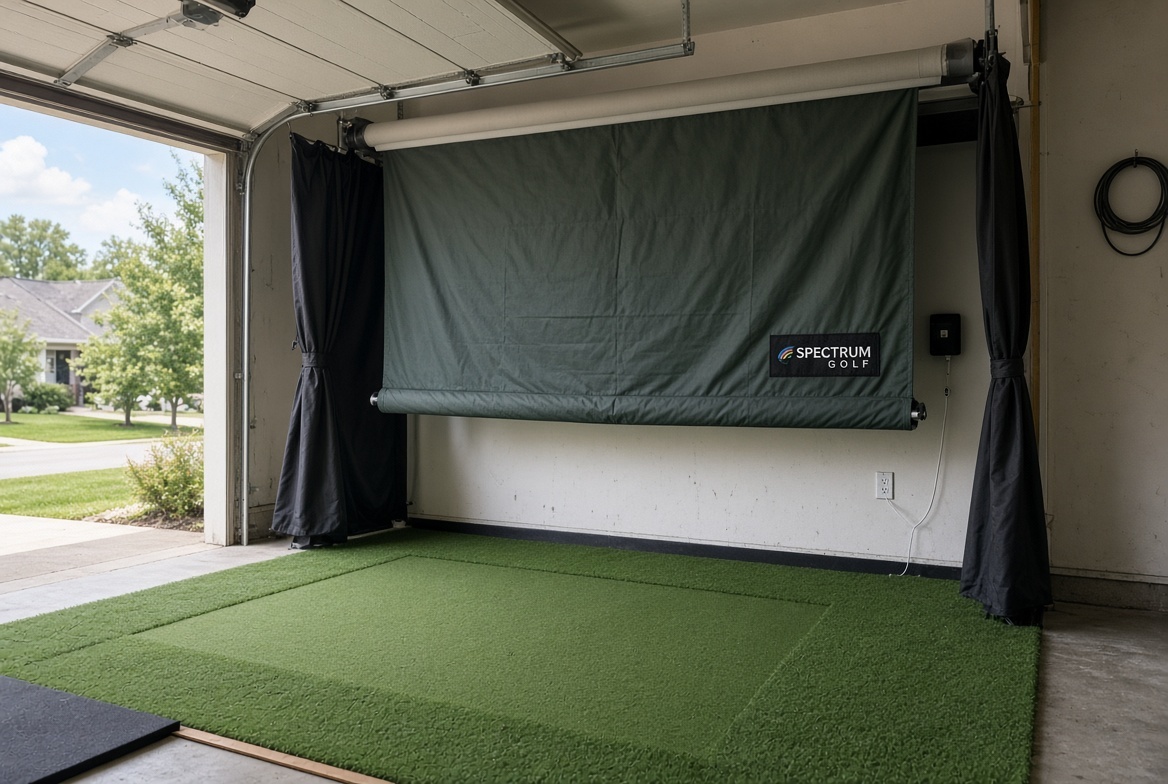
First is the simple roll-up golf impact screen. It moves the image surface but leaves you responsible for side netting and ceiling protection. For a careful golfer in a purpose-built space, that may be enough to start planning; it is not a complete enclosure by itself.
Second is the hybrid retractable enclosure. SportScreen Vanish LITE, for example, rolls up the front screen while its side curtains slide and pin back. The company lists a rear membrane, impact screen, curtains, ceiling panel and baffles in the package. This hybrid arrangement is an attractive compromise for garages where keeping the wall clear matters more than making every component motorized.
Third is the more fully retractable studio with side screens and additional coordinated protection. SportScreen describes its Vanish series as rolling up by crank or remote, with ceiling and side elements included. Read the actual assembly instructions, because an enclosure that retracts at the push of a button may still need clearance and a clear path for each panel. Those distinctions are why “retractable golf simulator” is not a sufficient product specification.
The strongest case for a fixed enclosure
A fixed golf enclosure is surprisingly hard to beat in a spare bedroom converted permanently to golf, a golf teaching studio or a commercial simulator lounge. There are fewer moving parts, permanent protection can be built around the hitting zone, and you can align projection and launch-monitor placement once. Every visit begins in the same environment.
Fixed does not have to look like a pop-up tent. A custom golf simulator enclosure can be built around wall finishes, black side panels, careful lighting and a screen that fits the room rather than merely occupying it. An integrated look is often more valuable than the novelty of a disappearing wall. The freedom to design deep ceiling baffles and wider side coverage is especially relevant when beginners and guests will use the bay.
When a business plans an indoor golf facility, operational consistency counts. Staff must be able to check the hitting surface and protections quickly. A retractable system can still work, but should earn its place through an actual need for multipurpose use, rather than a vague belief that motors are always more sophisticated.
The strongest case for retractable
Retractable systems are for people whose real estate has other responsibilities. Think garage golf simulators that become parking again, shared home gyms, family rooms that host movie night, or event spaces that change function between bookings. The more valuable that reclaimed space is, the more justifiable the extra hardware becomes.
A motorized retractable golf screen may also protect the impact surface from casual contact when the bay is inactive. That is only a partial protection benefit; dust, moisture and storage conditions still matter. A motor does not turn fabric into a sealed storage case. The more important benefit remains the ability to remove a large visual and physical element from a room.
For homes with low patience for setup rituals, a thoughtfully designed motor-and-curtain arrangement can be a genuinely elegant solution. Just budget for the entire bay: screen, roller, sides, ceiling, padding, suitable mat, projection, power and maintenance access. If the enclosure can retract but the hitting mat occupies the garage’s only parking position, the family may be less impressed than the product brochure.
A room-by-room decision guide
In a one-car garage that still houses a vehicle, start with a retractable enclosure study. Measure parked-vehicle clearance, roller clearance, garage opener travel and the location of ceiling obstacles. If the screen cannot roll above the car or the side panels interfere with the door, an alternative bay location may be wiser.
In a dedicated basement, begin with a fixed custom enclosure. Take the full swing with the longest club you intend to use, check projector geometry and plan side protection around your most unpredictable shot. In a finished living room, the answer depends on aesthetics and household tolerance: a hidden screen can preserve the room’s purpose, while a gorgeous built-in can become the centerpiece.
In a commercial facility, calculate hours of intended use and operational downtime. A fixed bay earns points for repeatability, while a retractable option can make sense for event spaces or training rooms shared with other activities. Match the system to the room’s schedule, not the other way around.
Before ordering: the 11-measurement reality check
Measure the room width at floor height and at roller height, because buildings rarely respect perfect rectangles. Record finished ceiling height, obstacles, swing clearance, available screen width, projected image area, safe rear gap, side-wall gap, hitting position, mounting structure and power access. Then separately record the maximum dimensions of the item that must return to the room, whether that is a car, treadmill or holiday-decoration mountain.
Ask the screen supplier which dimensions refer to overall unit width, fabric width, visible image width and mounting bracket width. Those numbers are frequently different. SportScreen publishes separate projectable-area measurements for its models, which is exactly the sort of distinction a buyer needs. A nominal “11-foot” enclosure is not automatically an 11-foot-wide projected image.
And make a real swing before ordering. Use a safe unloaded club, evaluate movement in all directions, and obtain appropriate professional advice on structural mounting or electrical work. For full-system component planning, start with Spectrum’s simulator setup guide.
Verdict: buy back the space you actually need
Choose a fixed golf simulator enclosure when the room is dedicated, fast repeatable practice matters and you want to avoid mechanisms you will rarely use. Choose a retractable golf simulator enclosure when the space truly needs to transform and the full setup can be stowed safely. Choose a hybrid when restoring the front wall is valuable but permanent side protection is impractical.
The smartest choice is often obvious after a tape measure and one honest conversation about how the room is used. Spectrum can help match impact screen materials, custom dimensions and compatible retractable hardware to the space instead of forcing the space to match a predetermined kit. Explore golf impact screens and the SportScreen/METech-compatible poly spacer option, then contact Spectrum with room dimensions, photos and how the area must function when you are finished playing.
If you are ready to build, request a custom screen and enclosure fit review through Spectrum Golf. Bring the measurements and the awkward ceiling details. Those are precisely the details that separate a simulator you use for years from a very expensive object that lives where the car used to.
Frequently asked questions
Can I use a normal projector screen as a golf impact screen?
A standard home theater projection screen is not designed to absorb repeated golf ball impacts. Choose material specifically intended for golf ball impact, installed with the appropriate clearance and protection.
Are impact screens and enclosure frames the same purchase?
Often they are separate. Always inspect the listed contents for the screen, rear support, sides, ceiling, frame, baffles, roller, projector and launch monitor.
Can I install a golf simulator myself?
Some kits are suited to careful DIY assembly, but electrical work, structural anchoring and unusual ceiling conditions may require qualified professionals. Follow the model-specific installation requirements.